Validators
A distributed validator network with specialized roles, deterministic consensus, and broad participation.
Retium operates a dual-token economic model designed for long-term sustainability, predictable costs, and direct alignment between network participants and network health. There is no inflation, no coin printing, and no passive income. Every coin earned is backed by real work performed on the network.
Proof of Math (PoM)
Retium introduces Proof of Math. In PoW, block structure is decided by energy expenditure. In PoS, it is influenced by token ownership. In PoM, mathematics determines which blocks can exist.
Every block ID is derived from prime number factorization. A block's position, parent links, and relationships are calculated deterministically. Validators do not choose block structure — they execute what the math dictates.
Forks are mathematically impossible. There is no mining race, no leader election, and no longest-chain rule.
Validator Roles

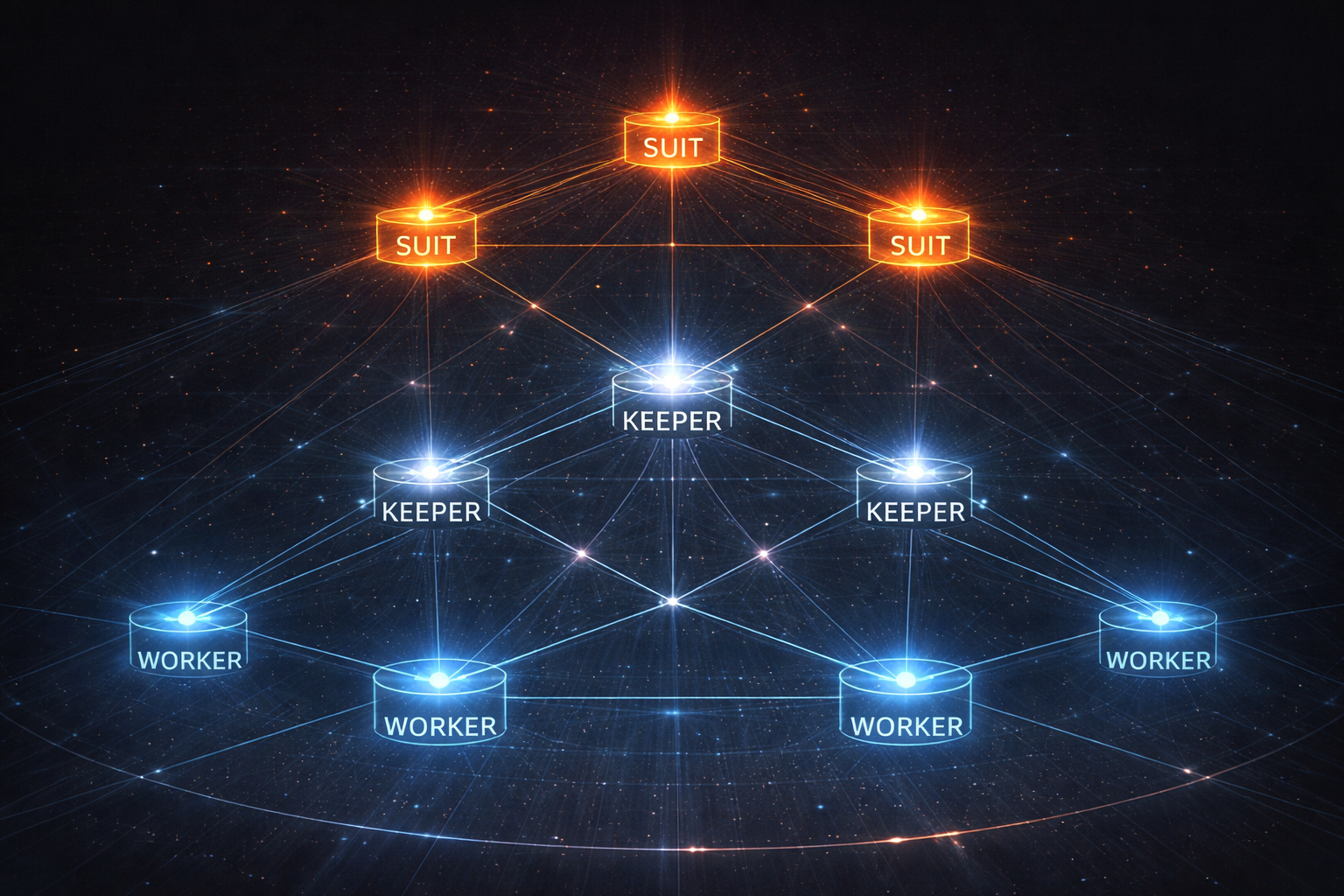
Keepers
Plan blocks, coordinate the network, store full mesh state, manage tick advancement.

Workers
Validate transactions before they become final or rejected. Workers independently check that each transaction is legitimate, correctly formed, and safe to execute. Most accessible role.

Suits
Coordinate block finality, verify deterministic Keeper consensus, and synchronise the network on each block's verdict.
How Validation Works
Retium separates transaction validation from block finality. When a transaction enters the network, it is routed directly into an open block instead of waiting in a mempool. The Matchmaker assigns five Workers to check the transaction. If at least three Workers approve it, the transaction reaches transaction-level finality.
Blocks are sealed on a fixed cycle, not only when they are full. This keeps the network rhythm predictable, even during low or uneven traffic.
After a block is sealed, the Keeper layer checks it through deterministic consensus. Keepers independently recompute the same mathematical result from the same inputs. When a majority of Keepers agree, the block has reached cryptographic consensus.
Suits act as finality coordinators. Five independent Suits are assigned to each sealed block, and they coordinate block finality by watching for Keeper agreement. Once the required Keeper consensus is reached, a Suit broadcasts the finality verdict and the block becomes HardFinal.
Keepers also manage the tick cycle, which controls the broader rhythm of block production. Each tick represents a new phase of mesh growth, and the network advances only after the current phase is finalized.
The Matchmaker keeps assignments dynamic and unpredictable, so validators do not know in advance which transaction or block they will handle. This helps prevent coordination and keeps validation independent.
 Instant Confirmation
  Consensus Secured
 Hardware Requirements
Keepers
Highest load — full mesh state, coordination, storage, persistent connections, GPU-capable server hardware.

Suits
Moderate requirements — block validation, moderate compute and storage.

Workers
Lightest by design. Stateless, hold only current vote assignments. Can potentially run on phones, tablets, and laptops.
Easy Validator Setup
A validator pack includes the official node binary and required configuration. Setup involves staking, downloading the validator pack, and running the node. Each node verifies its own binary signature at startup using an embedded Ed25519 public key.
A dedicated desktop application is included in the pack.
Setup Steps
Stake RTM
Lock tokens for your chosen role
Download Validator Pack
Official binary + configuration
Run Node
Auto-verifies binary signature at startup
Begin Validation
Start earning from network fees
Security and Rotation
Validator rotation prevents collusion. Matchmaker assigns fresh quorums for each validation event. RotationLog prevents repeated grouping. All network messages are signed with Ed25519. Binary attestation ensures software integrity. Slashing penalizes false votes, malicious behavior, and protocol violations.
 Dynamic rotation
  Ed25519 signing
  Slashing penalties
  Anti-collusion
  Binary attestation
  Software integrity
 Become a Validator
Join the Retium network and earn from real transaction fees.
 Become a Validator